Before the Modern Public Meeting: How Assembly Became a Civic Form
How assembly became a civic form: see how medieval English parish meetings turned local custom into recorded decisions that could be revisited beyond the gathering.
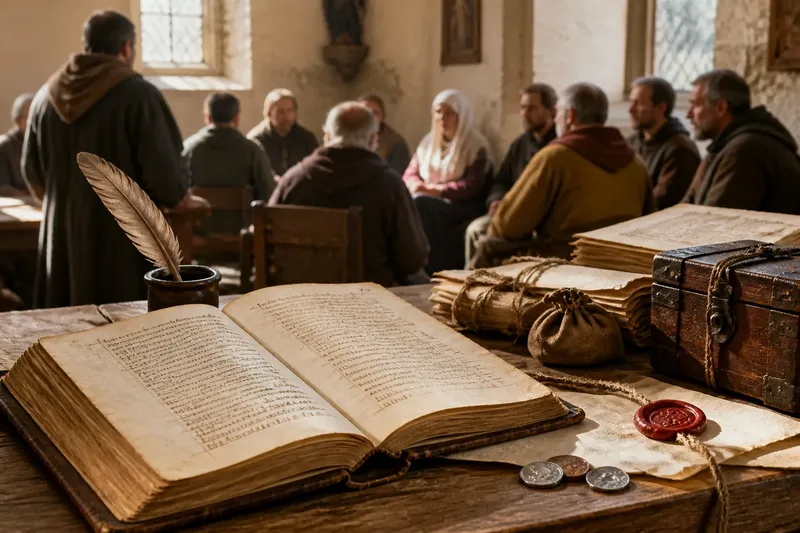
How assembly became a civic form is visible in the records of medieval English parish meetings, where local people gathered to address shared obligations. The move from spoken custom to written accounts did not create public participation from nothing; it changed how a gathering’s decisions could be remembered and carried forward.
There was no single origin or universal sequence. Different societies developed their own forms of assembly, shaped by local authority and custom. The parish example offers a specific way to examine one change: a gathering could remain rooted in local practice while leaving a written trace for people who were not present.
Parish meetings joined local affairs to written records
In medieval England, the parish was a local religious community as well as a setting for practical administration. Parishioners and local officers dealt with matters that could include maintaining church property and meeting responsibilities attached to the parish. The precise arrangements varied, so no single parish meeting should stand for every community.
Churchwardens were local officers associated with parish responsibilities, and written accounts could record their handling of funds and goods. Such documents offer evidence of practical administration, but they do not provide a complete transcript of discussion or prove that every resident could take part on equal terms.
This distinction matters. An account can show that a payment was recorded or an obligation recognised; it usually tells less about who proposed a course of action, who objected, or how the gathering reached agreement. The record preserves an institutional trace, not the whole sound of the meeting.
Writing changed what a gathering could leave behind
In a gathering organised mainly through memory and custom, participants might know when a matter was settled because they heard the decision and recognised the local practice. A written account could make some parts of that process available later, especially where officers needed to explain or continue their work.
Writing was not simply a better version of memory. A clerk or officer chose what to record, and the surviving document could emphasise obligations and transactions over disagreement or informal discussion. Like a label on a storage box, a record helps people find what was kept but cannot show everything that happened while it was being packed.
For historians and citizens alike, the sensible question is what a document can support. A recorded payment supports a claim about an entry in an account; it does not, by itself, establish that a meeting was open, representative or free of pressure.
Local assembly and wider authority overlapped
Parish affairs did not exist apart from wider religious and political authority. Local officers acted within obligations set by institutions beyond the immediate gathering, while local customs shaped how those duties were handled. Assembly could therefore be both a place for local action and a point where wider rules took effect.
This overlap helps explain why the history is not a simple march from informal gatherings to modern democracy. A meeting could handle a limited local responsibility without having authority over every resident or every issue. The name of a gathering alone does not tell us its powers; the surviving records and the rules around it matter.
Written administration also made continuity possible when particular participants changed. An incoming officer could consult an earlier account rather than rely entirely on the recollection of a predecessor. That continuity strengthened institutional memory, even as the written record left some voices and exchanges out of view.
What can parish records tell us?
Were medieval parish meetings democratic?
That depends on what is meant by democratic, and the records alone rarely settle the question. They can show local administration and obligations, but they do not establish equal rights to attend, speak or decide.
Did writing replace oral custom?
No. Written accounts could sit alongside remembered practice and spoken discussion. A document might preserve an outcome while customary knowledge continued to guide how people handled matters in the room.
Why do records leave out parts of a meeting?
Accounts were made for particular administrative purposes, not necessarily to capture every argument or contribution. What they include reflects the recorder’s task and the institution’s needs, so silence in a record is not proof that no discussion occurred.
How can I assess a historical claim about assembly?
Ask what kind of source supports it and what that source was made to do. An account book, a legal rule and a narrative description each preserve different evidence, and none should be treated as a complete picture on its own.
Read a record by separating evidence from inference
When examining a historical meeting, distinguish what the document states from what you infer about participation. Note the type of record, its purpose, who produced it and which matters it includes. Then ask what evidence would be needed to support any larger claim about access or authority.
Imagine a parish account lists a payment for repairing a church roof but says nothing about how the repair was agreed. The supported conclusion is that the account records a payment for that purpose; the decision-making process remains unknown unless another source describes it.
This approach keeps the history specific without pretending that a surviving page is a window onto every conversation. How assembly became a civic form is best understood through particular settings such as the English parish, while keeping visible the limits of the evidence and the different paths taken elsewhere.
For present-day readers, the useful lesson is about records rather than a ready-made model of participation: a document can carry a decision forward, but its silence should prompt careful questions, not confident assumptions about who had a voice.