Why Institutional Roles Are Easier to Understand as Relationships
Institutional roles as relationships help you identify who decides, carries out and explains a public action, so your questions reach the right body.
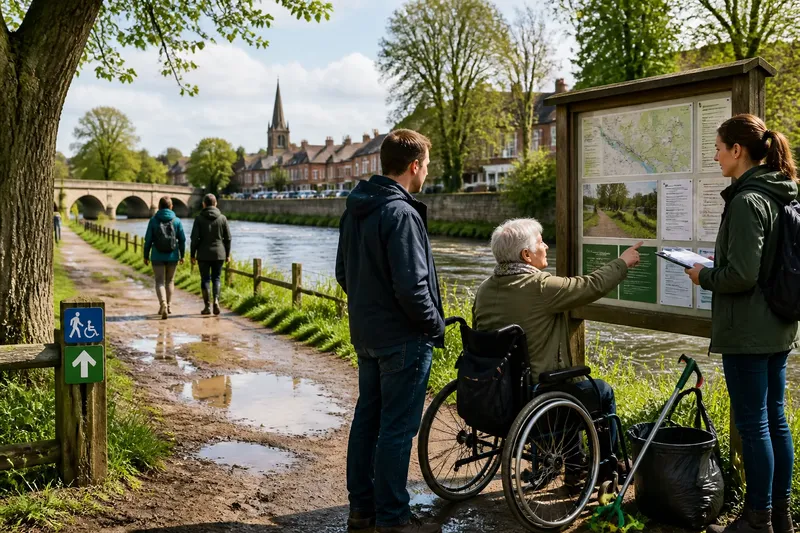
Who can authorise a public action, and who must explain what happens next? Institutional roles as relationships help answer that question by showing how a decision moves between bodies, rather than treating a familiar name as responsible for everything.
Imagine the fictional town of Mereford, where a riverside footpath becomes hard to use after heavy rain. Residents want the route made accessible again. The council receives access complaints, a regional water authority manages the land, and a volunteer group clears litter nearby. Each has a connection to the path, but those connections do not amount to the same responsibility.
Begin with the decision residents need
Instead of starting with the most visible institution, name the specific public question. In Mereford, residents need to know who can approve work on the path, who will arrange it and who will explain whether the access problem has been addressed.
Those questions call for different evidence. A sign may identify the land manager, a council webpage may name a complaint contact, and a volunteer notice may describe local activity. Read each as evidence of a particular role, not as proof that one organisation controls every aspect of the site.
- Authority: Check whether a document names a body that can approve, refuse or set conditions for the proposed work. If it does, ask that body about its decision; if it does not, ask who holds that power.
- Advice: Check whether a technical or local view is requested. If advice is recorded, distinguish it from the decision; if it is absent, ask whether relevant expertise or user experience was considered.
- Delivery: Check who is assigned to arrange or perform the authorised action. If a contractor is named, ask which body commissioned or oversees the work; if no delivery party is named, ask who will organise the next action.
- Public explanation: Check which body is meant to update residents. If a contact route is stated, use it for progress questions; if not, ask the decision-maker to identify the public contact.
- Oversight: Check whether an organisation is expected to review completion or respond to concerns. If oversight is assigned, ask what it checks; if no one is identified, ask the relevant bodies who will confirm the outcome.
- Scope: Check whether a stated responsibility covers this location and this kind of problem. If the wording is specific, apply it to that issue; if it is broad or unclear, ask for the boundary in writing before assigning blame.
These roles can overlap. One public body might decide and oversee a job while a contractor carries it out. The contractor’s work matters, but performing a task does not automatically make it the body that chose whether the task should happen.
Follow a public decision through its hand-offs
In the invented Mereford situation, residents send a report to the council’s access team. The team forwards the location to the water authority. The authority asks a drainage adviser for a view, decides that a repair is appropriate, and asks a maintenance contractor to schedule it. The council then tells residents what stage the work has reached.
That sequence gives each connection a distinct meaning: the council receives and relays the concern, the authority decides what may happen on its land, the adviser contributes information, and the contractor carries out authorised work. The volunteer group’s litter-clearing does not, by itself, assign it responsibility for drainage or access repairs.
To make a map, write the public question at the top of a page. Add each named body beneath it and draw arrows labelled with the actual exchange: “complaint sent”, “advice requested”, “permission given”, “work assigned” or “update issued”. Use a question mark beside any link that is only an assumption. Like sorting letters into separate trays, this keeps different kinds of responsibility from being mixed together.
Distinguish influence from formal responsibility
Residents can shape an institution’s understanding without holding the power to approve a repair. For example, a person who uses a wheelchair may point out a barrier that is not obvious from a brief site visit. That information can inform a decision, but providing it does not transfer the decision-maker’s formal responsibility to residents.
The reverse distinction matters as well. A public body may approve an action but rely on another organisation to deliver it. If work has not been scheduled, ask who currently holds the next action, who oversees the arrangement and who will explain the delay. A clear answer separates the immediate hold-up from the duty to account for it.
Separate the decision from what people can observe
A sentence such as “the council did not fix the path” can conceal several different questions. Did the council control the site? Did it pass the complaint to the land manager? Did that manager approve work? Was the work assigned and completed? Did the result address the access concern residents actually raised?
Consider a fully invented continuation: the water authority has approved a repair, but residents have received no update. They check the authority’s written response, which names a contractor but gives no schedule, and the council’s reply, which says it will pass on progress but does not claim to control the work. Residents then ask the authority whether the contractor has been instructed and ask the council when it will relay an update. The resulting answer may show that scheduling is still pending while the council remains the communication route. That clarifies the next questions without proving that the repair plan is adequate.
Assess the outcome against observable evidence: the decision and its stated conditions, any work visible at the site, and the access problem that remains. Approval tells you what was decided; visible work tells you that an action took place. Neither alone establishes that the route now meets the needs residents described.
Use documents to check what each body says it does
Look for documents tied to the particular connection you are trying to understand: a land notice, a published remit, a meeting record, a written complaint response or a description of a contractor’s role. Verbs such as “approve”, “advise”, “maintain”, “refer” and “report” can signal different tasks. Keep the document and the claim it supports together in your notes.
Separate what is explicit from what you infer. “The notice names the water authority as land manager” is narrower than “the authority is responsible for every problem on the path”. The broader claim may depend on agreements, the type of issue or the exact boundaries of the land.
If two documents appear to conflict, record both statements and ask what each covers. A council page might name the public contact while an authority letter identifies the decision-maker. Ask each body what it handles in this specific matter, what it has passed on and who owns the next action.
What should you ask about institutional roles?
Who can make the decision?
Ask which body can approve, refuse or set conditions for the action in question. A team that receives a complaint may be only the route into the process.
Who is expected to carry out the action?
Ask whether the work is assigned to public staff, another body or a contractor. Then ask which institution commissioned or oversees it.
Who should explain a delay?
Ask which organisation holds the next action and which one must keep residents informed. If those duties sit with different bodies, ask both about their part.
What would resolve the concern?
State the problem residents reported and ask what observable change would address it. A completed job may still leave that problem unresolved.
Make a fair assessment from the relationships
Before judging a public outcome, note the question at issue, the body with decision-making authority, the sources of advice, the delivery party, the public contact and any oversight role. Mark uncertain links instead of filling them with assumptions. This makes it easier to direct a challenge to the right body without treating visibility as proof of control.
For Mereford, the written account might show that the council receives access complaints, the water authority decides what can happen on its land, an adviser informs that decision and a contractor performs authorised repairs. Residents can then ask whether the referral occurred, whether the authority explained its choice and whether the completed work addressed the reported barrier. Institutional roles as relationships make those questions more precise, while leaving room to criticise a poor decision or an unsatisfactory result.
When an institution points elsewhere, ask for the name of the body it contacted, the action it passed on and the person or team responsible for the next public update. That small request turns a vague hand-off into something residents can follow.